




Took this tent to the whitsunday islands few weeks ago. 25 knot winds. It was bullet proof. Space inside was well designed, practical and plenty of space. Super light and easy to set up. Super happy







Ships in 24 hrs

Easy returns

Lifetime Warranty*


ALL ALTON PRODUCTS ARE COVERED BY A LIFETIME WARRANTY.* CLICK HERE TO LEARN MORE.
ALL ALTON PRODUCTS ARE COVERED BY A LIFETIME WARRANTY.* CLICK HERE TO LEARN MORE.
ALL ALTON PRODUCTS ARE COVERED BY A LIFETIME WARRANTY.* CLICK HERE TO LEARN MORE.
ALL ALTON PRODUCTS ARE COVERED BY A LIFETIME WARRANTY.* CLICK HERE TO LEARN MORE.
| Capacity | 1 - 1.5 Person |
| Season Rating | 3.5 Season |
| Floor Dimensions | 207 (Length) × 65 (Head Width) × 100 (Middle Width) × 48 cm (Foot Width) |
| Internal Height | 102 cm (at highest point) |
| Vestibule Width | 60 cm (at widest point) |
| Fly Material | 10D Ripstop Nylon, Silicone/PU coating 1500mm |
| Inner Material | 15D Nylon + 10D Nylon Micromesh |
| Floor Material | 20D Ripstop Nylon, Silicone/PU coating 2500mm |
| Trail Weight (Tent Inner + Tent Fly + Poles + 6 Pegs) | 1.220kg |
| Total Packed Weight | 1.440kg |
| Total Packed Dimensions | 41 × 12 × 12 cm |
| Collapsed pole length | 39 cm |
| Poles | DAC Featherlite® 8.5mm (NFL) |
| Pegs | DAC Featherlite® J-Stake (F) (7g) |
| Capacity | 1 - 1.5 Person |
| Season Rating | 3.5 Season |
| Floor Dimensions | 81.5 (Length) × 25.5 (Head Width) × 39.5 (Middle Width) × 19 in (Foot Width) |
| Internal Height | 40 in (at highest point) |
| Vestibule Width | 23.5 in (at widest point) |
| Fly Material | 10D Ripstop Nylon, Silicone/PU coating 1500mm |
| Inner Material | 15D Nylon + 10D Nylon Micromesh |
| Floor Material | 20D Ripstop Nylon, Silicone/PU coating 2500mm |
| Trail Weight (Tent Inner + Tent Fly + Poles + 6 Pegs) | 2lbs 11.0oz |
| Total Packed Weight | 3lbs 2.8oz |
| Total Packed Dimensions | 16 × 4.5 × 4.5 in |
| Collapsed pole length | 15.5 in |
| Poles | DAC Featherlite® 8.5mm (NFL) |
| Pegs | DAC Featherlite® J-Stake (F) (0.2oz) |
1 × OUTER FLY TENT
1 × INNER TENT
11 x DAC FEATHERLITE® J-STAKE (F) PEGS
3 x DAC FEATHERLITE® (NFL) POLES
3 x KNOTLESS ADJUSTABLE GUYLINES
1 x SIDE ENTRY COMPRESSION CARRY BAG
Weighing 1.440kg all up, Alton’s 1-Person Lightweight Tent is for hikers who are serious about real-world reliability – not just flashy specs that sound good online, but fail in the field. Engineered for wilderness conditions, every aspect of this tent has been strategically chosen to deliver maximum protection and durability while still being light and compact. Tough ripstop nylon, DAC Featherlite® poles, premium 10D no-see-um micromesh: it all adds up to give you an Lightweight 1-Person Tent that delivers seriously reliable shelter.
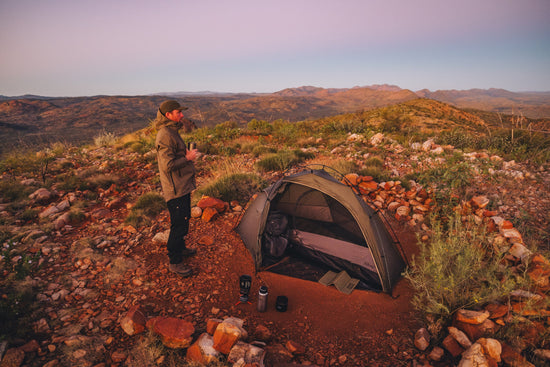
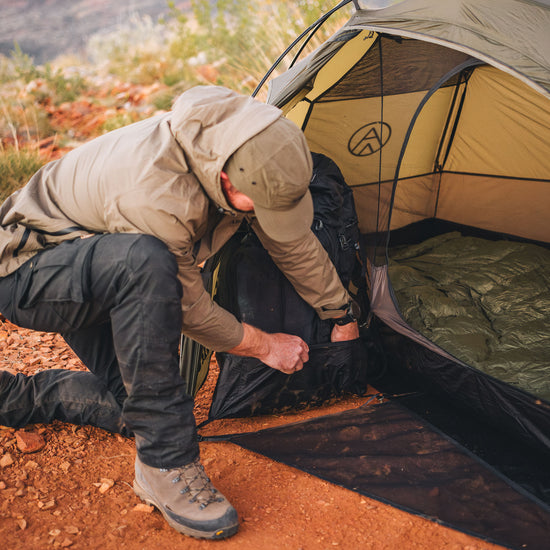
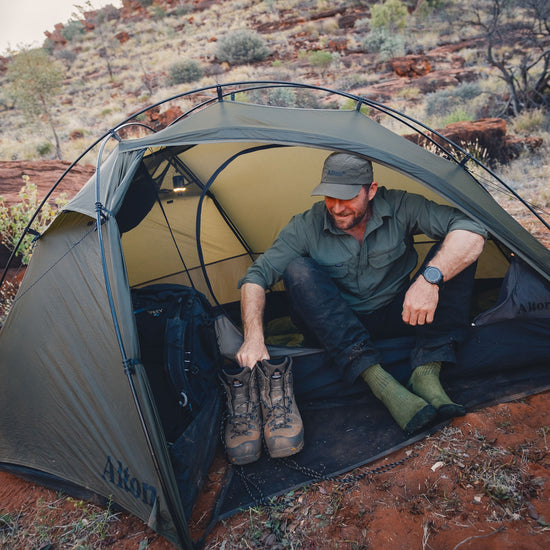
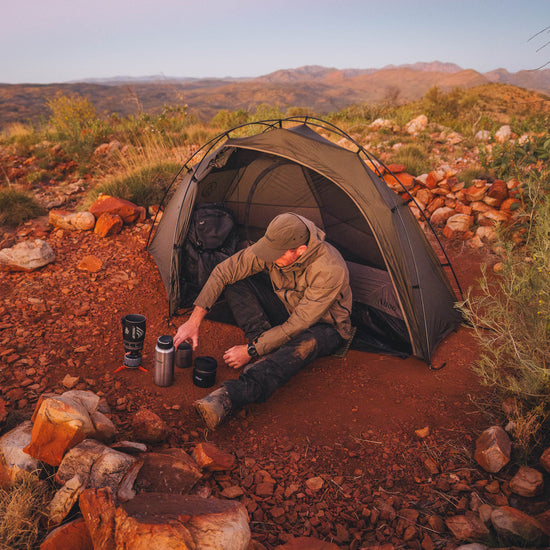
Alton’s Lightweight Tent is intentionally designed to feel bigger and roomier than your standard 1-person tent without adding extra weight. The secret is our streamlined geometry: tapered at the ends, the tent expands to 100cm wide and 102cm high in the middle. That equals more usable floor space, easy entry/exit, and plenty of room for you to sit up. Plus, with built-in overhead storage cache and a large vestibule area for storing bulky items like your pack, cooking equipment, and boots, you don’t have to worry about your gear getting wet – or in your way.
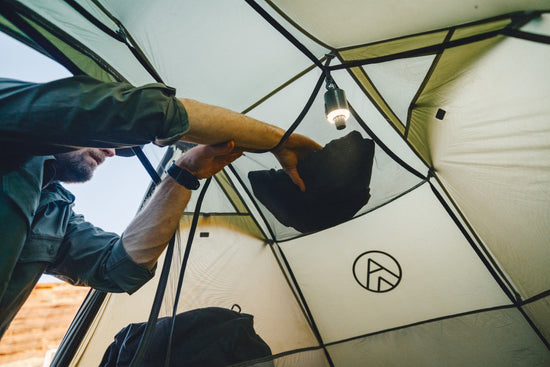
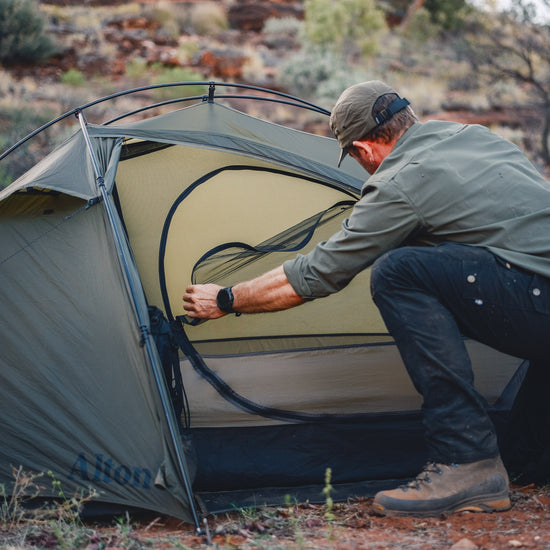
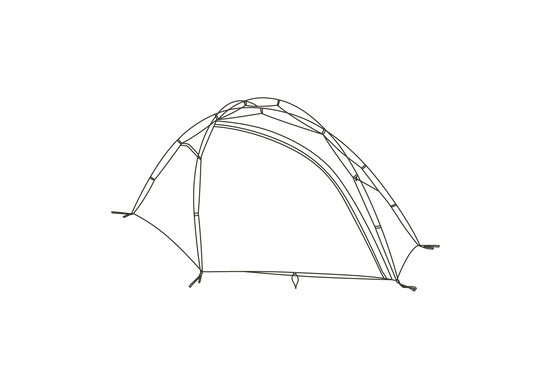
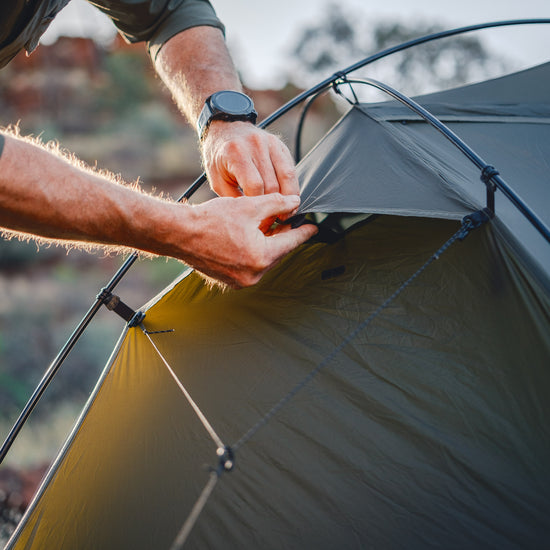
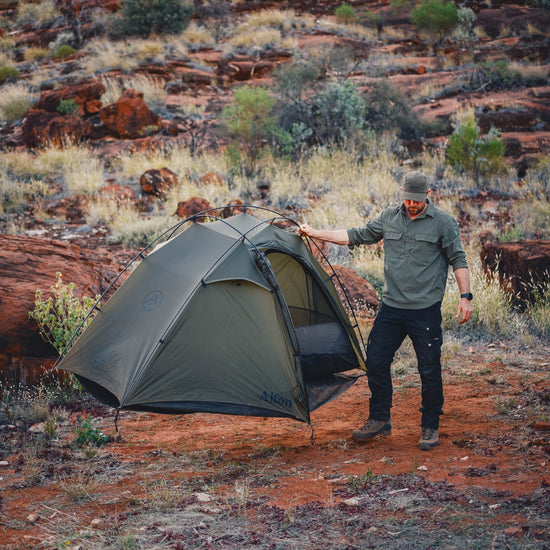
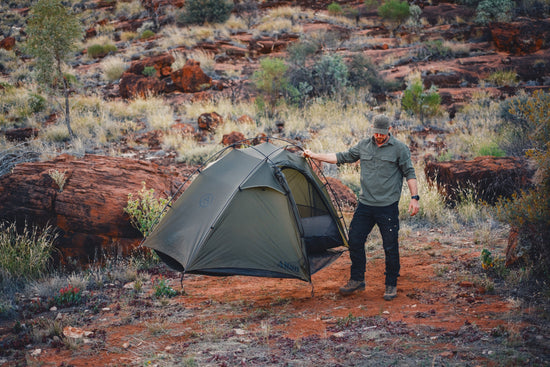
We developed our Lightweight Tent to have an external frame architecture that’s freestanding, lightweight, and highly weatherproof. The tri-pole exoskeleton geometry reinforces the shelter from the outside, making it more resistant to wind and light snow loading, while the fly-first setup means the inner tent stays dry during setup. In wet conditions, the RainGuard™ Door System, with an outward opening door and built-in rain gutter, minimises dripping inside the tent. For lightweight missions, leave the inner mesh at home for a versatile, single layer tent option that is still highly protective in inclement weather.
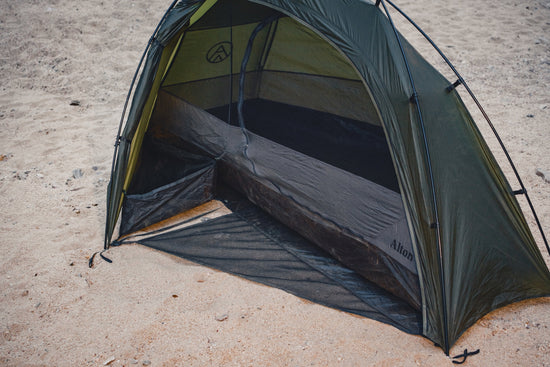
Customise your setup and unlock extra functionality and protection for your Lightweight 1P Tent with purpose-built accessories. Get more life out of your tent with the Tent Footprint, which acts as a barrier against mud, moisture, and sharp debris. If you’re camping in cold, wintery conditions, the 4-Season Inner improves heat retention and boosts warmth. In clear, dry conditions, the Stargazing Kit allows you to use your 1P Tent without the fly, converting it into an ultralight mesh shelter.
Tent season ratings are intended to provide a rough guideline for what conditions a specific tent is suitable for.
A 3-season tent is designed for use in spring, summer, and autumn conditions. Most 3-season tents will feature a full or partial mesh interior and a waterproof tent fly, enabling you to adapt the level of coverage to suit the conditions. However, a 3-season tent is not intended for use in snow, and may lack some of the structural resilience required to handle harsh winter weather and below freezing temperatures.
A 3.5-season tent is built to handle more demanding conditions, including light snow loads, strong wind, and heavy rain. The materials will generally be slightly stronger and more durable than those found in a 3-season tent, and the design may vary to prioritise stability and weatherproofing.
A 4-season tent takes things up a notch. They are specifically designed to deal with extremely strong winds, heavy snow loads, and winter storms.
Whether or not a 1-person tent is worth it or not really depends on how you like to camp. If you’re someone who often goes on solo trips or who prefers not to share a tent, then having a 1-person tent is probably the most efficient option for you.
With a 1-person tent, you can save weight and space in your pack, lightening your load so you have more capacity to carry other essentials. They’re also great when you are camping in rough terrain, where campsite space may be limited, as a 1-person tent can be pitched in places where a 2-person or 3-person tent just wouldn’t fit.
For these reasons, 1-person tents tend to be the preferred option among solo hikers, bikepackers, bushcrafters, and hunters.
The waterproof rating of a tent is called the hydrostatic head, which refers to how much water pressure (measured in millimetres) the fabric can withstand before it starts to leak.
To put that in real terms, a tent fly with a 1,500mm hydrostatic head rating can hold a 1.5m column of water before any moisture begins to seep through.
The higher the hydrostatic head rating, the more water pressure the fabric can resist. But higher doesn’t always equate to “better”.
Higher hydrostatic head ratings (over 2,000mm) typically require thicker fabrics and extra layers of coatings to achieve that level of waterproofing, which can result in the tent being much heavier, stiffer, and bulkier when packed.
And while some ultralight fabrics such as Dyneema Composite Fabrics are highly waterproof, they are less durable and considerably more expensive than silnylon alternatives.
Tents with higher hydrostatic head ratings tend to be much less breathable, making them more susceptible to condensation, so you end up feeling damp inside the tent, anyway.
For all these reasons, going for the highest hydrostatic head rating won’t always mean you’re going to get a better tent. Instead, we recommend focusing on the quality of the fabric and construction, coating type, seam sealing, and overall design, as these all play a huge role in how dry your tent will stay in real world conditions.
A high-quality tent with a hydrostatic head rating between 1,200-1,800mm for the outer fly and 2,000-2,500mm for the floor is more than enough waterproof protection for typical outdoor conditions, including rain, wind, and yes, even the occasional storm.
If you regularly camp in severe conditions, including high winds, prolonged or driving rain, heavy snowfall, or severe storms, then a hydrostatic head rating of 2,000-3,000mm for the outer fly and over 5,000mm for the floor may be advisable.
Before we answer this question, it’s worth clarifying what “10D” actually means. 10D is referring to the fabrics denier, which is the standard unit of weight for a single thread/yarn of any given fabric.
The dernier number is based on the weight of 9km (don’t ask why) of a thread of a specific thickness. So, 9km of a 10D thread weighs 10g, and 9km of a 20D thread is 20g, and so on.
As you can see, the denier tells us how heavy an individual thread of fabric is… but not much else. This is why you can have two 10D fabrics made from different materials, with completely different weights, thicknesses and durability levels.
When it comes to judging how durable a tent’s fabric is, denier is just one tiny piece of the puzzle. Other factors like the material (eg. ripstop nylon vs polyester), thread count, weave pattern, and coating composition are also important.
Our Lightweight Tent’s outer fly is made from 10D ripstop nylon with a 1,500mm silicone/PU coating, and the floor is made from a 20D ripstop nylon with a 2,000mm silicone/PU coating.
We utilise a high-tenacity ripstop nylon with a square grid, meaning there are thicker, stronger threads woven in a square grid pattern throughout the fabric. Combined with a high thread count, this dramatically increases the tear strength while keeping the overall weight very low.
Then there’s our dual silicone/PU coating. We’ve specially formulated the coatings to offer the best performance and longevity in outdoor settings. Not only is this coating waterproof, it also increases the tear strength, UV-resistance and durability of the fabric. The silicone coating soaks in and bonds with the fabric, rather than just sitting on top.
On the inside of the tent fly and floor, we’ve opted for a thin polyurethane (PU) layer, which provides better adhesion with seam tapes, ensuring fewer potential leak points. This also reduces some of the slipperiness that can come with silicone coated tent floors.
So 10D outer fly and 20D floor might not sound like much, but the reality is that it’s not the denier that makes this fabric exceptionally durable, but all these elements working together.
But “durable” doesn’t mean indestructible.
Your Lightweight Tent can (and will) still sustain damage if it’s stabbed by sharp branches, dragged over debris, or exposed to heavy abrasion. We recommend using the Lightweight Footprint to protect the tent floor, and avoid setting up in places where shrubs or branches are rubbing against the fly.
We back our Lightweight Tents with a Lifetime Warranty* against manufacturing defects in materials or workmanship, but that’s not a free pass to abuse it. Take care of your tent, and it will take you further.
Knowing how to properly clean and care for your tent is an important outdoor skill and can help keep your tent functioning for longer.
After each trip, we recommend unpacking your tent and allowing it to air dry in a well-ventilated area out of direct sunlight. Leave it until it is completely dry, as packing it away while damp can damage the fabric or lead to mould growth over time.
At the same time, take the opportunity to give it a spot clean. To do this, shake or brush out any debris, then use a soft cloth with a cleaning solution that’s formulated for outdoor gear, such as Nikwax Tech Wash®, to clean any dirt or marks you can see on the fabric.
If a deep clean is required, this should always be done by hand. Fill your bathtub or a large bucket of water with lukewarm water and add some suitable technical wash, using the dilution ratio specified on the bottle. Work over the fabric using a sponge or soft cloth, then rinse thoroughly to remove any soap residue. Gently wipe off the excess water with a towel first, then hang on the clothesline or on a rack and leave to air dry completely.
If you use your tent frequently (30+ nights per year), we recommend applying a waterproofing or solar-protective treatment, such as Nikwax SolarProof® once a season.
Overall rating: 4.7 / 5 from 26 reviews.
Took this tent to the whitsunday islands few weeks ago. 25 knot winds. It was bullet proof. Space inside was well designed, practical and plenty of space. Super light and easy to set up. Super happy

These are the stupid flimsy tent poles they give you. I’ve tried to straighten it best I can. Literally bent terribly after the first use. Would not recommend for the price

I've just come back from using my 1P lightweight tent in the wild and it has performed exceptionally well. As I was heading coastal for three nights and subject to low overnight temperatures with wind and drizzling rain, I fitted up the 4 season inner. Not only was I isolated from the chilling external wind but I was able to use my sleeping bag as a quilt because it wasn't that cold inside. In fact, I was able to leave the external door flap fully open (facing away from the breeze) in complete comfort. There has been some unkind criticism of this tent design online, suggesting that it is prone to condensation causing the inner and outer to adhere to each other. Well, that would depend on the ambient conditions; no tent will be perfect, but I did manage to allay that potential problem by pegging out the left foot-end wall (see photo) which kept them both layers separated. It's no biggie. I'm still very happy with my purchase!

Went for an overnight camp and used the tent for the first time. Was so easy and roomy. I love the inside & outside storage areas . I posted a reel on our Insta page. https://www.instagram.com/reel/DXm-RhhE6VC/?igsh=cHAyODFsOWRzZ21j

Took it out thinking the weather wasn’t going to be too bad. Ended up being 30km/hour winds and rain to top it off. I woke up dry and on the ground!! Couldn’t be more over the moon with the purchase

Completed three week walk on section of Te Araroa in NZ with a stack of Alton’s gear. All performed really well. Due to a mishap I lost the tent. Didn’t want to buy another brand as the tent performs really well. Quick exchange of emails while hiking in Kapiti and Alton arranged purchase and DHL to Wellington. Arrived in 2 days. Here it is on the Queen Charlotte Sounds section. Thanks guys.

Love this tent, the very first night I used it, it rained ALL night and not a single drop of water or wetness inside. The vestibule tub means you can rest knowing everything is dry and off the ground, I could easily pull down inner while raining in the morning and keep that dry and seperate and keep outer up to pack up your pack etc. the space was great inside and it packs up nice and small.

Used for few nights doing part of Yurigar trail. Great tent, delicate but seems pretty hardy. Some nifty features for sure. Paired with R4 sleep mat combo (including fitted sheet, that is awesome and worth the extra 300 grams). Very happy so far.

Awesome overnight in the Blue Mountains. Mount Solitary and Ruined Castle was brilliant.

Took it out this weekend and it was great Love the storage outside for your pack and the mat at the door for the foot print Very happy, will differently be taking it out next snow season

Awesome complete stand alone tent, first day I used it I got hit by a thunderstorm Tent held up perfectly and kept me warm and dry. great product and great price. I will definitely being buying more of these for my students.

Pitched the tent in the yard just to get a feel for the setup process and the tent as a whole. This is my first tent so give my review some grace, these are just my thoughts. I’m 6.4ft and with a sleep mat if you’re sleeping on your back, depending on where your sleep mat settles, your head or your feet can push the inner tent body onto the outer tent body, if it’s raining I’m not sure if that will cause an issue with water getting in or not but just a thought I had, it may not though, if you look at the material in between the tent floor and the inner bug mesh there seems to be a water resistant material like the rain fly, idk if this matters to most people but it rains where I live so I’m curious how it’ll hold up, besides that it’s a cozy tent, well thought out storage and functionality that feels useful and valued, super intuitive to set up AND pack away, surprisingly! And aesthetically, if your into green, it’s dope!!, I’m looking forward to seeing how this tent holds up in tougher conditions, like rain and wind, though I’m not looking forward to the maintenance it takes to keep your tent healthy after the fact but that’s neither here nor there, Also would be cool to see the community input on the tent later down the road, positive or negative.

Used this a few times now. The most exceptional tent on the market. All features and not flash fluff. It handled high winds in winter on the Tasmanian Highland lakes with zero complaints. The first 1p tent ever with only use able features I have owned.
So happy with my lightweight tent. Love the attention to detail in the design of this product: in particular the seperate pocket outside of the inner tent means that you don't need to access the main tent when taking your belonging out and therefore not letting potential bugs going in! The design of the tent makes it quite spacious too. Thank you Alton!
Really great. Similar weight but smaller packdown than my non-freestanding tent with some new smarts built in. Very pleased with this purchase.
Easy set up. Light weight and compact size for overnight camping. quality materials kept me and my gear dry. Made a significant difference in comfort but also with the ability to pack the essentials in my pack due to its size (not consuming so much space). Would recommend.
I bought this tent to replace a very very expensive lightweight tent I hated. Sure the Alton tent weighs a couple of hundred grams more (about the weight of a decent steak), but this Alton tent Is phenomenally easy to unpack, erect, dissemble and stow. It makes an amazing free standing shelter that keeps you dry and out of the wind. Best camping money I’ve spent yet. Only thing on a par is my Alton Hammock.
I'm impressed with the design of this one person tent. The free standing design is a big plus and it is surprisingly roomy for one person (unless you're over 182cm tall). My only minor complaint is that the clips on the three straps that attach the tent to the pole cross-overs are fiddly and will be hard to do up with cold gloved fingers; adding a tensioning strap/buckle would help a lot.
Used this on a trip on the two bays trail in Victoria for it's crash test. Fantastic and roomy for a one man.
Easy to put up. Light to carry only 1.4kg More than a drizzle of rain, you're going to have a problem. Zipper to access outer vestibule when inside would be handy. Partitioned inner shelf would be quality of life improvement. Would buy again.
Looked at a lot of one person tents before purchasing the Alton. This tent ticked all the boxes. Excellent design, acceptable weight, roomy, easy to put up and an Australian company. Impresses each time I use it. Recommend this item to anyone wanting a well made quality tent.
Great design and build quality down to the finest details. I have just returned from my first hike using it and couldn’t be happier.
Perfect 1 p lightweight hiker tent. Easily use with or without fly. Free standing, heaps of space. All top quality fittings, I have only used in fine weather, but can't see any problem with using in wetter conditions.
A little too heavy to be ultra-light, its definately much sturdier built than a lot of lightweight gear which sacrifice longevity. Storage bag is appropriately sized so you don't have to struggle to perfectly fold/roll when out in the bush. Also on-par for price if you have to import equivalent US/EU kit. The vestibule allows you to keep your dirty stuff dry, but separate from the clean sleep area. Perfect for solo hunting/ hiking trips. Well done Alton!
Outstanding, not a coffin like other 1 man tents, heaps of room, the vestibule area and pack storage is a so handy, got the foot print also, would recommend that to complete the use in all areas. even the storage bag is a great design. look forward to how far this will take me. really happy and worth every cent. Cheers
Absolutely love this tent! Showed up fast and took it out camping on the weekend. Super easy and intuitive to set up and lighter than I expected. Packs down small too. You can tell the build quality is legit. Really impressive stuff, Alton has nailed it as usual